









Six decisions to settle before opening the Young Talent 2027 season

Six decisions to settle before opening the Young Talent 2027 season
Six design decisions a Young Talent programme needs to settle before November, drawn from VCO Group analysis of more than 21,000 applications in Vietnam.
Six decisions in brief
Six decisions a Young Talent programme needs to settle before November, drawn from VCO Group analysis of more than 21,000 applications in Vietnam.
Most of the outcome of a Young Talent Program season is determined by six design choices, and all six decisions have to be settled before the campaign opens. VCO Group has drawn these six decisions from an analysis of more than 21,000 applications in Vietnam, with a proposed timeline for completing them before November.
Why these six decisions must be settled up front rather than adjusted mid-season
A Young Talent Program season runs for several months and has plenty of points at which adjustments can be made. But there is a group of decisions where changing course midway breaks the comparability of the entire dataset, or creates inconsistency between candidate groups within the same intake.
Score thresholds are the clearest example. If the threshold changes after some candidates have already been scored, the programme is running two different standards in one season, and that is very hard to explain if challenged. Consent wording in the form is the second example: consent not captured at the point of application is almost impossible to recover afterwards.
The six decisions below belong to that group. They do not take long to settle, but they do have to be settled at the right time.
For programmes opening in the first quarter of 2027 on the timetable common in Vietnam, a sensible deadline for completing the six decisions is the end of November 2026, leaving roughly six weeks for system configuration and testing.
The six decisions and their timings
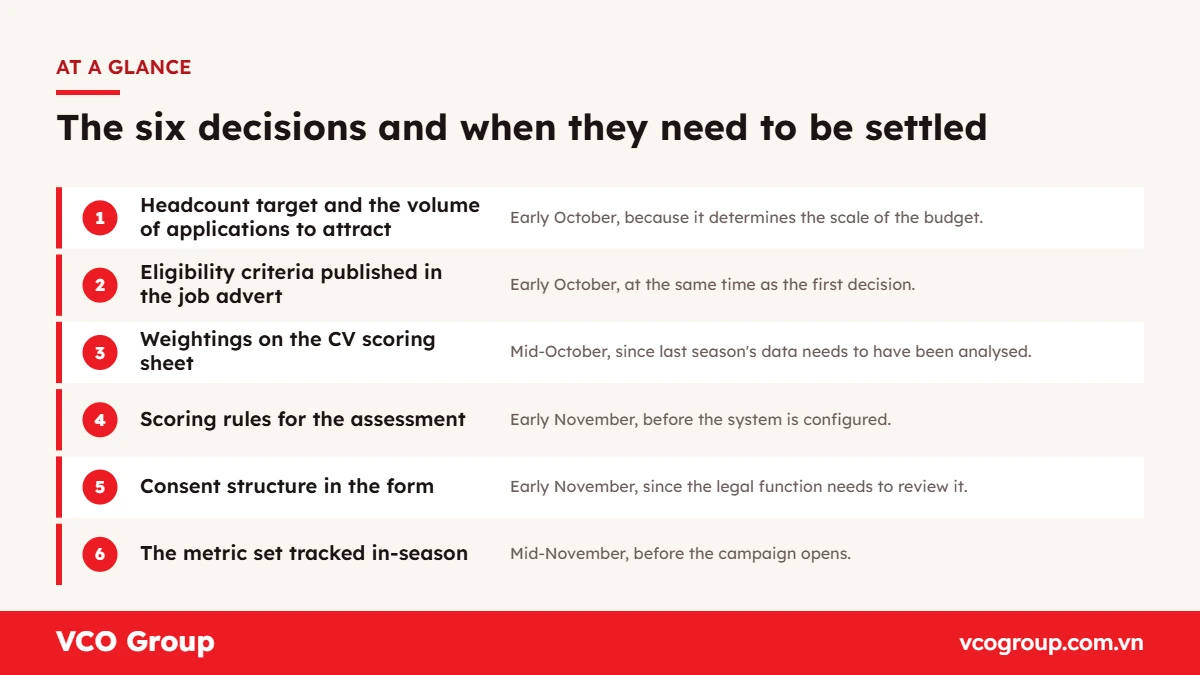
The table below orders the six decisions by dependency, meaning each decision needs the outcome of the one before it.
The six decisions and when they need to be settled
| Decision | What needs to be settled | Proposed deadline |
|---|---|---|
| Headcount target and the volume of applications to attract | Work backwards from the number of candidates needed at the interview round through each conversion rate, rather than setting a target on total applications | Early October, because it determines the scale of the budget. |
| Eligibility criteria published in the job advert | Decide whether to keep or drop the academic grade requirement and other pre-filter conditions | Early October, at the same time as the first decision. |
| Weightings on the CV scoring sheet | Review the weighting of each criterion against last season's data, and add a standardisation step by age band | Mid-October, since last season's data needs to have been analysed. |
| Scoring rules for the assessment | Choose between a uniform threshold and a weighted average with a floor, and settle the threshold by percentile | Early November, before the system is configured. |
| Consent structure in the form | Split consent layers by purpose, and decide which layers are mandatory and which optional | Early November, since the legal function needs to review it. |
| The metric set tracked in-season | Choose the metrics to be measured, and set up the linking of channel spend data to candidate data | Mid-November, before the campaign opens. |
Of the six decisions, the sixth is the one most often left until last and also the one that cannot be reconstructed retrospectively. Cost per qualified candidate by channel can only be calculated if the tracking was set up before the campaign ran.
Three principles running through all six decisions
The first principle is to keep resource allocation decisions separate from candidate screening decisions. Target university lists, media channels and event calendars all belong to the first group. CV scoring criteria, score thresholds and weightings belong to the second. A signal useful for allocating resources is not necessarily strong enough to justify rejecting a specific individual, and conflating the two groups is the source of most of the distortion found in scoring sheets.
The second principle is that every comparison across seasons, channels and groups must rest on score distributions rather than pass rates. A pass rate is a product of a threshold the programme itself has set, so it describes one particular season but does not compare across contexts.
The third principle is that every major change should run in parallel with the old approach for a full season before replacing it outright. Among the six decisions, this applies most clearly to the fourth, on assessment scoring rules. Running in parallel adds no material cost, but it gives the recruiting team a body of internal evidence to present, and that is usually the deciding factor in whether a change is approved.
Market context to factor into 2027 planning
The three sets of facts below should be built into the assumptions section of the plan.
On domestic recruitment demand, VietnamWorks' second quarter 2026 recruitment market report records the national hiring index continuing to rise year on year, with Hanoi overtaking Ho Chi Minh City on both scale and growth rate, and the gap between hiring demand and candidate supply widening further in several sectors. TopCV's annual report, built on a survey of more than 3,000 employer and worker representatives together with an analysis of nearly 300,000 job adverts, provides a more detailed supply and demand picture by sector.
On regional pay pressure, AON's survey of salary increases across Southeast Asia places Vietnam among the leaders with a projected rise above seven per cent, ahead of Indonesia, the Philippines, Malaysia, Thailand and Singapore. This bears directly on the starting salary a young talent programme needs to publish in order to compete.
On the longer-term trend, GMAC's 2026 corporate recruiters survey records one third of employers globally reporting that they have replaced at least part of their entry-level work with artificial intelligence. For a programme recruiting young candidates, the implication is not to cut headcount targets but to review whether the competency set being assessed still matches the work new joiners will actually be doing.
One thing to start even while the season is still some way off
Beyond the six decisions above, there is one piece of work worth starting early because it only yields results after several seasons: linking selection data to performance review data once candidates have joined.
All of the analysis in this body of work stops at the first two rounds of the recruitment process, because that is the scope where large-scale data exists. No conclusion is drawn about whether candidates who pass those rounds go on to perform better, because that question requires data from the later rounds and time to follow up.
Any company that starts capturing this link from the 2027 season will have its own answer around the end of 2028. That is the most persuasive form of evidence in any discussion about recruitment process design, because it comes from the company's own candidate pool and its own working context.
What it takes is not complicated: preserve the candidate identifier all the way from application through to the HR system, and schedule one reconciliation at six months and one at twelve months. The prerequisite is that the consent structure in the fifth decision covers this purpose.
Three things to do
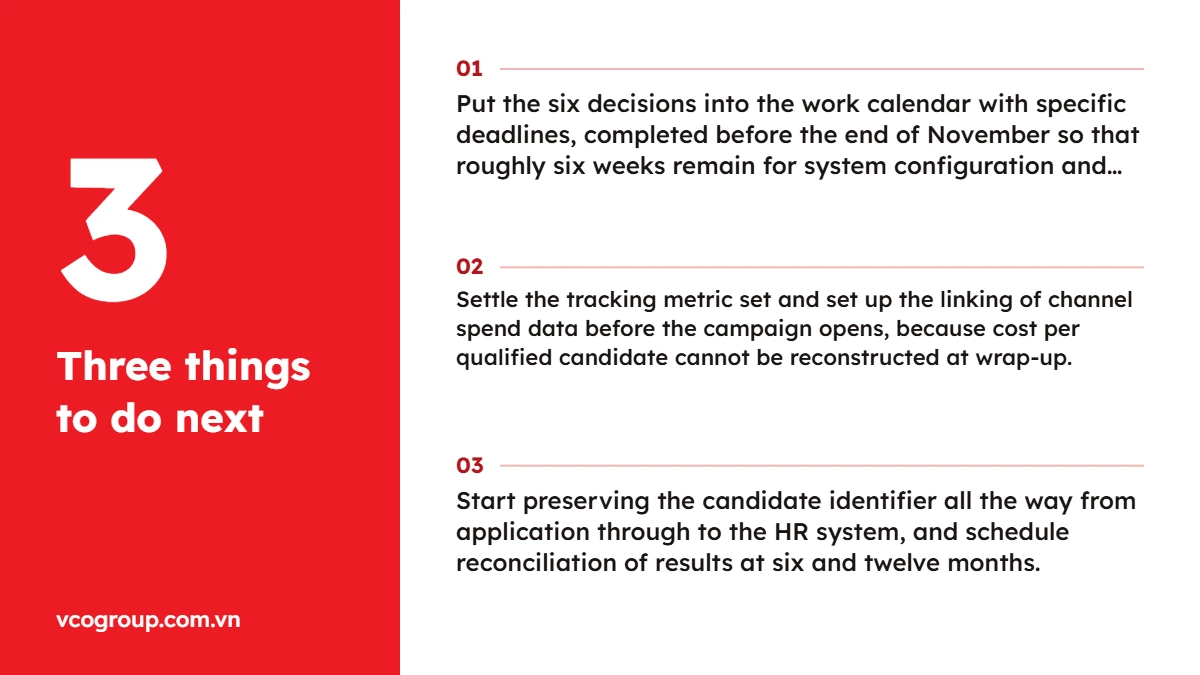
- Put the six decisions into the work calendar with specific deadlines, completed before the end of November so that roughly six weeks remain for system configuration and testing.
- Settle the tracking metric set and set up the linking of channel spend data before the campaign opens, because cost per qualified candidate cannot be reconstructed at wrap-up.
- Start preserving the candidate identifier all the way from application through to the HR system, and schedule reconciliation of results at six and twelve months.
Frequently asked questions
When does the design for the Young Talent 2027 season need to be settled?
For programmes opening in the first quarter of 2027 on the timetable common in Vietnam, the six decisions should be completed before the end of November 2026, leaving roughly six weeks for system configuration and testing before the campaign opens.
Which decision is most often overlooked when preparing a season?
The in-season metric set, and in particular the linking of channel spend data to candidate data. It is the only one of the six decisions that cannot be reconstructed retrospectively, because cost per qualified candidate by channel can only be calculated if the tracking was set up before the campaign ran.
Should scoring rules be changed in the coming season?
Prepare the change but run it in parallel rather than replacing the old rule immediately. Apply the old rule for formal decisions while also calculating results under the new rule and recording the group where the two diverge. After one season, the company has internal evidence to switch fully and a data-based case to present.
About VCO Group
VCO Group operates the assessment infrastructure behind Young Talent Programmes and Management Trainee schemes in Vietnam, covering application intake, aptitude testing, automated interviewing and Assessment Centres. VCO Group serves young talent and candidates with under three years of experience, working with large enterprises and multinationals in Vietnam. Its assessment and candidate management platform is called Testalents. Head office in Ho Chi Minh City.
If you would like to benchmark your own selection data against the market, or discuss the Young Talent Program Insight Report, contact Mr. Dung on 0334 889 068 or visit vcogroup.com.vn.
Related: see the young talent recruitment service from VCO Group, and the background on recruitment (Wikipedia).
Chia sẻ bài viết:


Tin liên quan
17 Aug - 2026
How many applications does a Young Talent Program actually need?
VCO Group analysed 21,000+ Young Talent Program applications in Vietnam to answer how many applications you need to fill your interview round.

17 Aug - 2026
Four metrics that should replace total applications in your hiring report
Total applications is the easiest number to see but says nothing about which channel works. VCO Group proposes four replacements for early-careers hiring reports.

17 Aug - 2026
One attraction campaign can serve two different hiring needs
One in four Young Talent Program applicants already has work experience. VCO Group data shows how to split the funnel without adding attraction cost.
17 Aug - 2026
The ability gap within one university is nearly 8 times the gap between universities
VCO Group data from 21,000+ applications shows the ability gap between candidates at the same university is nearly 8 times the gap between universities.

17 Aug - 2026
A baseline for testing every CV rejection criterion
VCO Group proposes a quantitative baseline for testing any CV rejection criterion, by comparing it against rejecting applications at random.